The 19th Water Science Development Forum was held in Nanning from April 17 to 18. Co-organized by the Water Science Research Center at Zhengzhou University, the Water Resources Commission of the China Society of Natural Resources, and the Water Conservancy Systems Technical Committee, Systems Engineering Society of China. The event was hosted by the School of Civil Engineering and Architecture of Guangxi University, Guangxi Water Conservancy Association, and Guangxi Engineering Research Center for Karst Water Security and Intelligent Regulation. Pinglu Canal Group Co., Ltd. and other institutions served as co-supporters.
Xiao Jianzhuang, President of Guangxi University, and Li Guixin, Second-Level Inspector of the Department of Water Resources of Guangxi Zhuang Autonomous Region, attended the opening ceremony and delivered speeches.
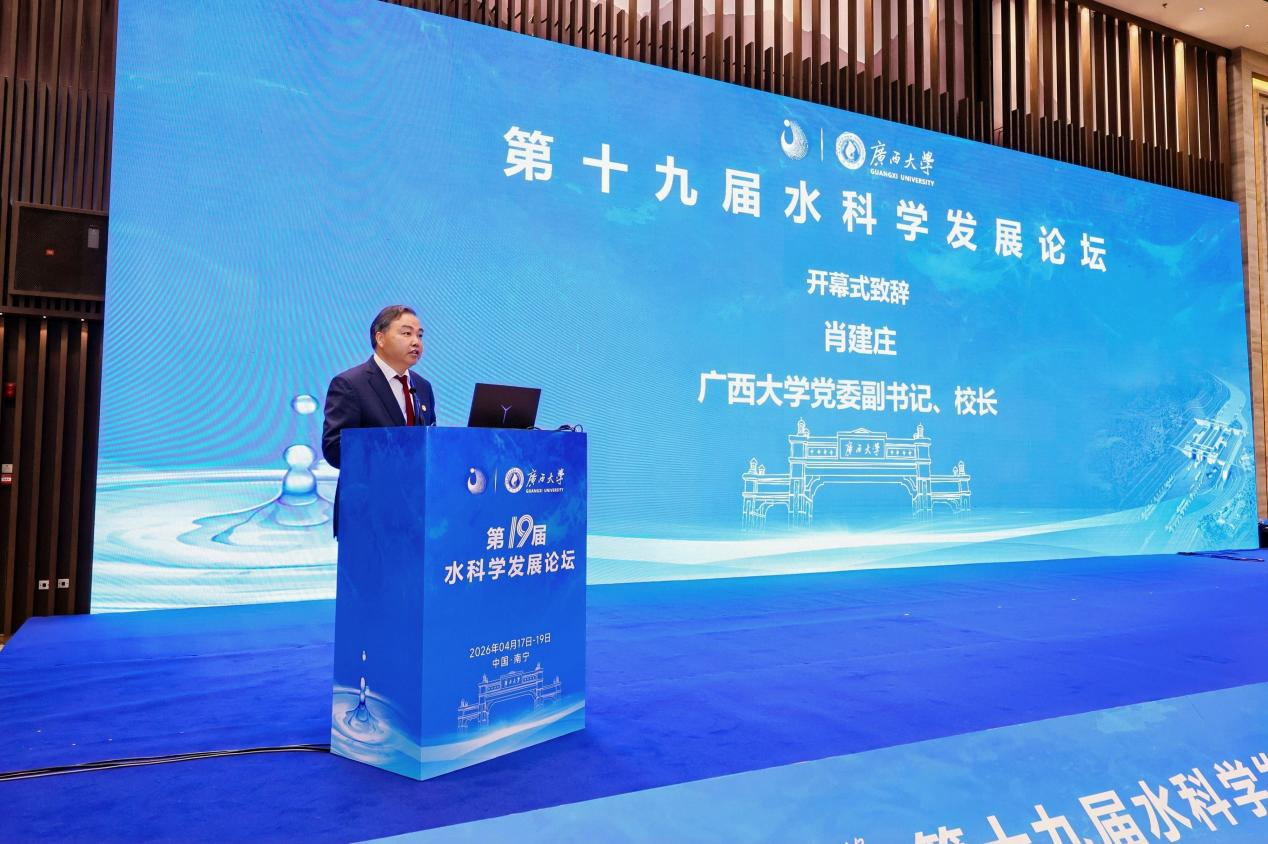
On behalf of Guangxi University, Xiao Jianzhuang extended a warm welcome and sincere gratitude to all participants. He observed that water science is a highly interdisciplinary area of study. Centering on the theme of “Smart Digital Water Network and Water Security Regulation,” the forum serves as a concrete move to implement the national strategies for water network development and smart water conservancy.
As the only "Double First-Class" and "211 Project" university in Guangxi, Guangxi University has made significant breakthroughs in key areas such as hydrological monitoring and forecasting, soil waste resource utilization, and digital twin smart platforms. These efforts are closely tied to major regional projects like the Pinglu Canal and the Guangxi Water Resources Allocation Project for the Beibu Gulf Region. Concurrently, the university is actively promoting the integration of "AI+" with water sciences, providing scientific and technological support for regional water security and marine engineering conservation.
Li Guixin pointed out that Guangxi is endowed with abundant water resources and has seen a substantial increase in investment in water conservancy development in recent years. The region’s total investment in water conservancy construction exceeded 50 billion yuan in 2025. Guangxi is accelerating the development of smart water conservancy by leveraging the Internet of Things, big data, artificial intelligence, digital twin and other cutting-edge technologies.
She emphasized that Guangxi is in urgent need of technical support in the utilization of water resources in karst areas, intelligent regulation of complex water systems, and water ecological conservation and restoration. Taking this forum as an opportunity, Guangxi aims to accelerate the development of a modern regional water network and consolidate the foundation of water security for Guangxi’s advancement in the Chinese path to modernization.
The forum adopted a "guided presentations + open discussion" format, attracting over 450 experts and scholars from 85 universities, research institutes, leading industry enterprises, and supporting journals across the country. Centered on four key themes—"hydrological modeling and digital intelligence empowerment, watershed water resources regulation and management, watershed water ecological protection, and digital-intelligent water networks and smart canals"—the event featured 20 guided presentations that facilitated in-depth academic exchange. This structure enabled substantive collision and convergence of scholarly perspectives.
Professor Zuo Qiting, founder of the Water Science Development Forum, and Director of the Water Science Research Center at Zhengzhou University, delivered a comprehensive summary of this year’s forum and announced the host unit for the 20th Water Science Development Forum.
The successful holding of the Forum has provided an effective platform for promoting the high-quality development of the hydraulic engineering discipline at our university. More than an event where innovative ideas were refined through dialogue, the forum also served as a committed practice of contributing expertise to the national water security strategy, jointly advancing the digital and intelligent transformation of water governance, and supporting the strategic goals of national water security.

 Home
>
News & Events
>
Events
Home
>
News & Events
>
Events


